Why There Isn't One 'Best' Butterfly Table Tennis Racket
The internet likes to make every buying decision look simple. Search for kettlebell and you'll get a quick answer. Search for dumbbell workouts for chest and you'll get a list. Search for how to code a video game and you'll get a step-by-step tutorial. Choosing Butterfly table tennis rackets is not like that.
I've been handling Butterfly equipment orders for about nine years. In that time, I've personally made—and documented—11 significant mistakes, totaling roughly $5,200 in wasted budget. I now maintain our team's pre-order checklist. It exists because I learned the hard way: there is no single right racket setup. The right setup depends on who you're equipping, how often it will be used, and how many you're buying at once.
Most of my useful lessons fall into three buying scenarios. If you're buying for a club, a school, or a resale business, one of these probably describes your situation.
Three Buying Scenarios
Here's the thing: a Butterfly racket for a competitive club isn't the same as one for a school program or a distributor's stock room. I'll walk through each one.
- Competitive Club / League orders
- School / Community Program orders
- Distributor / Reseller orders
Scenario A: Competitive Club / League
When you're buying for a club, you're not buying one racket. You're buying 20 or 40 individual setups. The biggest mistake I made was treating them as one order.
In September 2022, I submitted a bulk order for 30 rubbers: Tenergy 05, 2.1mm, because that's what our top player preferred. It looked fine on paper. Half the team used 1.9mm, and two players wanted Dignics 09C on their forehand. We had to peel 12 rubbers off blades before anyone used them. $840 in write-offs, a one-week delay, and a lot of red faces.
What I'd do now: get a spec sheet from every player before calculating the order. That means blade model, rubber model, sponge thickness, and color. It's boring, but it prevents the expensive mismatch.
- Confirm whether players want Tenergy, Dignics, Rozena, or Glayzer. They feel different.
- Order spare rubbers in the most common specs, not every spec.
- Consider batch consistency. If a team needs identical setups, order everything at once from a single authorized supplier.
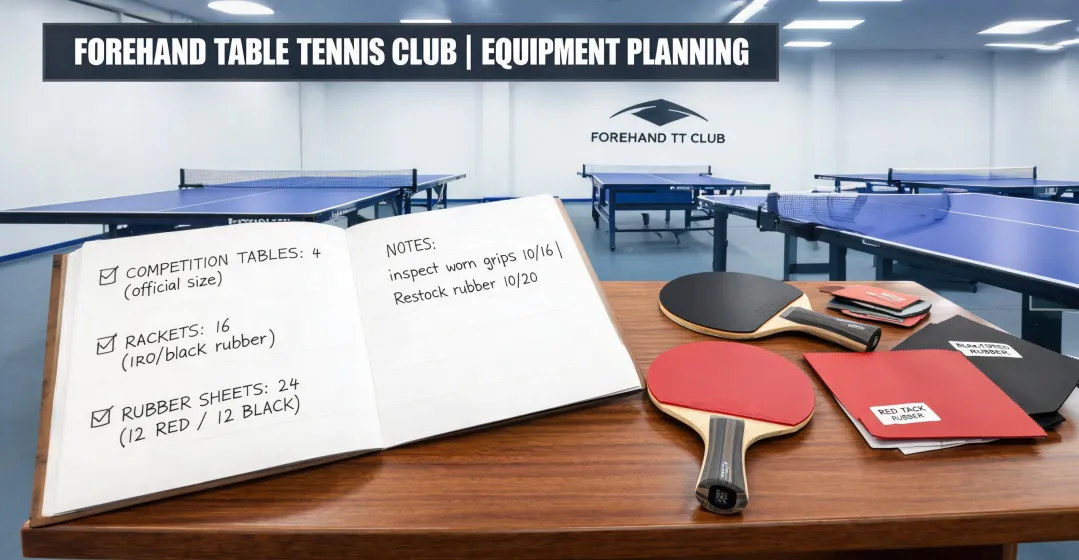
One rule I check before any tournament order: per ITTF regulations as of January 2025, a racket used in sanctioned play must have a red rubber on one side and black on the other. That's not a style preference; it's the rule. If players might compete, make sure every order follows it.
On the blade side, Viscaria and Timo Boll ALC blades are common in club orders. But I'm not a coach, so I can't tell you which blade will generate more spin. What I can tell you from an ordering perspective is this: if you standardize the rubber and let players keep their existing blade, you'll reduce reorders and unhappy emails.
Scenario B: School / Community Programs
If you're a school or community program, durability and replacement cost matter more than maximum spin.
A university team once asked me for 'the best Butterfly rackets.' If I'd sent Tenergy 05 on every bat, it would have wrecked their budget. Instead, we talked about their usage: beginners, 12 tables, sessions every day. They needed a dependable rubber that survives accidental table-edge contact and doesn't cost a fortune to replace.
For this scenario, I see more orders built around Rozena or Glayzer than Tenergy. Rozena is forgiving and controlled; Glayzer offers modern hybrid performance at a more accessible price. Pair either with a durable Butterfly blade and you have a setup that works for a wide range of players.
A practical detail: order 10-15% extra rubbers in the most common thicknesses. Programs break equipment, and a spare rubber avoids a long wait later. I can only speak to what clubs and schools have told me, so the calculus may be different if you're coaching elite juniors. But for a general program, keep it simple.
Scenario C: Distributors / Resellers
If you're a distributor, your question is not 'what racket is best for a player.' It's 'what inventory will move.' That's a different problem.
The mistake I see in my own history: stocking a long tail of niche rubber thicknesses just because one retailer asked. We bought 60 sheets of a specialty rubber and sold 14 in 18 months. The remaining 46 sat in inventory until the supplier changed the packaging. Not a technical loss, but dead cash.
For resellers, here's the pattern I'd recommend:
- Stock the most common tournament rubbers: Tenergy 05, Dignics 05, Dignics 09C.
- Keep Rozena and Glayzer in volume for the amateur market.
- Only stock blades that you can supply consistently. If you can't fulfill a blade and rubber combo reliably, don't advertise it.
- Don't base your pricing around a Butterfly table tennis sale unless your supplier actually gives you a discount you can pass on. A sale is not a strategy.
A legit sale is useful when it helps you fill inventory you already know sells. If a deal offers a discount on a top-selling rubber, buy deeper. If it's 20% off a slow mover, skip it. That rule would have saved me from one of my worst inventory mistakes.
Once, I saved $180 by buying a popular rubber from a non-authorized seller. The batch turned out to be counterfeit—or, rather, we discovered that only after a customer complained about bubbling. The replacement and return-shipping cost came to $1,400. Since then, I only buy through authorized channels. Period.
Current product specs are available from Butterfly's official website (accessed January 2025). Exact prices change by region and volume, so I won't quote numbers here. If a dealer price is dramatically lower than official pricing, treat it as a red flag.
How to Tell Which Scenario You're In
If you're still unsure, answer three questions:
- How experienced are the players? If they have established blades and know their rubber specs, you're in Scenario A. If they're starting from zero, Scenario B.
- How often will equipment be replaced? Monthly wear and tear means Scenario B. Seasonal demand points to Scenario A or C.
- Are you buying to sell to others? If yes, you're in Scenario C. Stop choosing your personal preference, and choose what your customers actually ask for.
When I'm still uncertain, I order a single sample setup first. It's easier to spend $80 on a test than to spend $4,000 on the wrong team order.
I know that isn't as satisfying as a five-step tutorial. But choosing a racket isn't like learning how to code a video game, where the logic is the same for everyone. The logic changes with the player and the purchase context.
At the end of the day, the best Butterfly table tennis racket is the one that matches your actual situation. My last two years have been much cleaner: 15 orders, no major write-offs. Not because I'm smarter now—because I stopped making decisions before defining the scenario.
Define the scenario first. It will save you the cost of learning the hard way.