Start With the Problem, Not the Product
I coordinate equipment orders for a Butterfly table tennis distributor, and I have handled more than 200 rush requests in the past six years. I still kick myself for one early mistake: a school needed a table for a weekend open house, and I never asked how wide the storage hallway was. The table arrived, folded, and could not get through the door. We paid extra freight, the school lost its event placement, and the lesson stayed with me. Since that day I lead with practical questions, not product specs.
So when someone asks which Butterfly table tennis rackets are best, I answer the same way every time: it depends. There is no universal best setup. There is only the right fit for your space, your players, and your deadline.
Start with your scenario. Not the brochure. Not the latest rubber. Scenario.
- Does the table need to be moved out of the room? If yes, a rollaway or centerfold table should be at the top of your list.
- Who is using the rackets? A beginner group, a rental desk, and a tournament player have completely different needs.
- Is a date already set? If you need equipment for an event in four days, the best product is the one that exists in stock and can reach you on time.
Those three questions separate the scenarios below. They do not fit table tennis into one neat answer, because it does not.
Scenario one: The room has another job
If your gymnasium doubles as a dining hall, exam room, or community rental space, the first spec is not playability. It is storage. You need a table that can be folded, moved, and secured quickly. For this situation, the Butterfly playback rollaway table tennis table is the compromise I recommend. That phrase means the table has a playback position for solo practice, wheels for moving, and a locking system that keeps it stable during play.
Here is the counterintuitive part: playback should not be your main reason for choosing that table. It is a warm-up feature. The ball comes back off a flat surface with a dull, predictable bounce, which is fine for loosening up, but it is not a training partner. You cannot simulate a real rally against playback. If your members need regular solo repetition, a table tennis robot like the Butterfly Amicus Prime is a better tool. Budget for that separately and treat playback as a bonus.
The practical detail is the delivery path. I once delivered a playback rollaway to a sports hall where the door opening was fine, but the lift was two inches too short. If the table cannot fit into the storage room, none of the marketing claims matter. Measure the fully folded height, width, and depth. Check doorways, corridors, lifts, and staircases. Write the numbers down before you ask for pricing.
I also tell buyers not to equate a more expensive table with a more suitable table. In a multi-purpose room, the priciest competition table can be the worst choice because it is heavier and harder to move. In a dedicated hall, the opposite is true. Let the room decide.
Scenario two: You are equipping many players
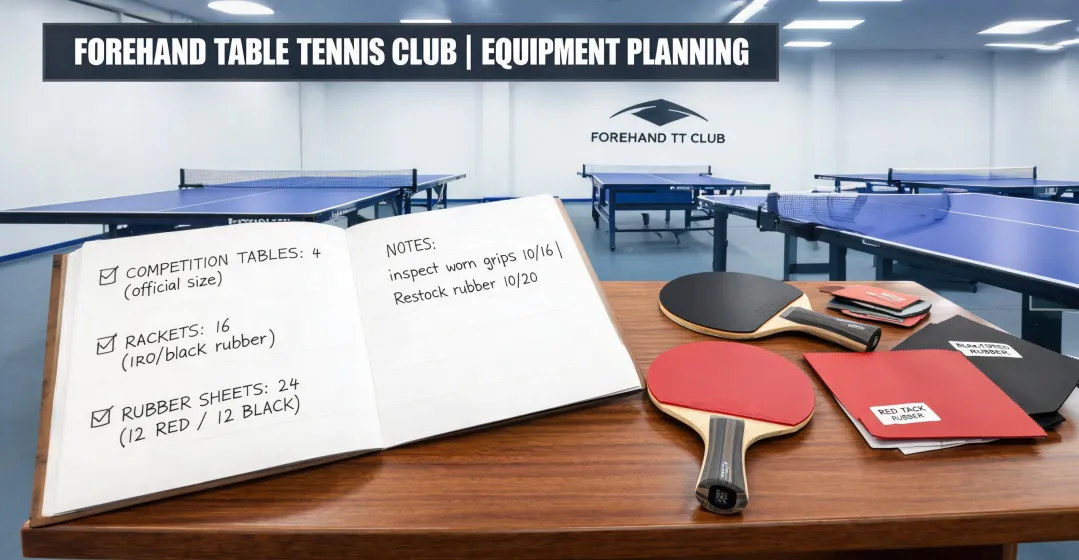
The phrase Butterfly table tennis rackets is used by very different buyers. A parent buying one racket for a child and a club director stocking twenty rackets are not making the same purchase. If you are stocking a club, school, or coaching program, my advice runs against the usual instinct of table tennis enthusiasts: do not build custom rackets for everyone. Custom rackets are higher performance, but they cost more, require rubber replacement, and create inconsistency for players still learning basics.
Start with a batch of identical pre-assembled Butterfly rackets. They offer predictable grip, decent rubber, and lower replacement cost. When all rackets are the same, a broken one can be replaced without changing the feel across the group. You also avoid tracking dozens of blade and rubber combinations.
I still regret one early purchase. I stocked advanced custom blades and rubbers for a club before the players had developed consistent strokes. The gear looked impressive in the cabinet, but it was too fast for most members, and the rubber got damaged by careless handling. I later switched most of the inventory to dependable pre-assembled rackets. Only the top performance group kept custom setups. That shift saved money and frustration.
Another reason to keep rackets simple is replacement. I have seen clubs lose a custom racket in a busy shared space and spend weeks trying to identify the exact blade and rubber thickness. With a standard pre-assembled racket, you order the same model again. Done. In a B2B setting, inventory simplicity is a feature.
When do custom Butterfly table tennis rackets make sense? When the player is a serious competitor who knows what they need. A common starting point would be a Viscaria or Timo Boll ALC blade with something like Tenergy 05 on the forehand and Rozena on the backhand. That is a high-level setup, and it is right for a much narrower group. It is not right for a community racket pool.
Scenario three: You have a dedicated competition space
Some facilities do not need to fold tables at all. They have a hall reserved for table tennis, and the tables stay in place for the season. In that case, stop looking for playback. Playback adds another mechanical hinge that can wear out, and you will rarely use it. Focus on playing surface, bounce consistency, and frame strength instead.
If there is any chance you will host local league matches, check the table model against the current ITTF list of approved equipment (ittf.com). A table marketed as competition grade is not the same as a table approved for competition. If it is not on the official list, you cannot use it for certain sanctioned events. That distinction becomes expensive after the table is inside your building.
Model names change by region, but a Butterfly Centerfold 25 is worth comparing with other tables that have a thick, stable top and strong legs. The top thickness affects bounce consistency. A heavier table is not a disadvantage here because it does not need to move often. The same table would be a headache in scenario one.
Surface care also matters. Competition tables should be covered when not in use, especially if the room gets direct sunlight. UV light can yellow the finish and change the bounce. Set aside budget for covers and basic maintenance. That is not a luxury item; it is how a serious table earns its lifespan.
Scenario four: The calendar has already won
This is where I may think differently from a typical salesperson. Because I handle urgent orders, I care as much about delivery risk as product performance. A great racket that arrives after the event is not a great racket. It is a return request.
When the deadline is fixed, work backwards from the date. Ask what is physically available in a local warehouse. Ask whether rackets are already assembled or still need rubber glued. Ask how many tables are on the truck and whether delivery can happen before the venue closes. If there is not enough time for a custom build, choose a stock model that can be ready the same day. Period.
In November 2024, an organizer needed fifteen rackets for a regional qualifier. The order came in on Wednesday afternoon for a Friday start. Custom rubber combinations at that volume carried too much risk. We supplied fifteen identical pre-assembled Butterfly rackets from local stock. They were not the most exciting option, but the event started on time. The client did not lose their entry fee. That outcome mattered more than any equipment debate.
I now use a simple internal rule for rush jobs: if custom assembly is required, we add a 48-hour buffer. If the buyer cannot give us that buffer, we switch to stock. This policy came from a missed deadline in 2023 that cost a client their event, and I have not repeated that mistake since.
One more urgent-delivery detail: ask about liftgate service. A full-size table is heavy. If the delivery truck has no liftgate and the venue has no loading dock, two people may not be able to unload it. I have seen an otherwise fast shipment fail at the last step. Confirm how the table gets off the truck and through the building before you approve freight.
How to tell which scenario you are in
You can usually identify your scenario with one question. After the last match, where does the table go tonight? If it stays in place, do not buy a playback model. If it has to disappear behind a door, measure the path and plan for a rollaway.
The second question is about rackets. How many players will use each racket this season? Many players and mixed skill levels mean durability and consistency should beat peak performance. One developing player changes that balance. The more specific the player, the more specific the racket.
The third question is about time. What happens if the shipment misses the date? If the cost of delay is low, you can chase an ideal product. If the cost of delay is high, stock availability becomes the top feature. Simple.
Butterfly makes strong equipment across the table tennis range. The reason buyers end up with gear they do not need is rarely quality. It is a mismatch between product and the operating reality of the facility. Help your client, or yourself, understand that reality first. An informed buyer asks better questions and makes faster decisions. That is better for everyone.
One final note: product lines and prices move. This overview was accurate as of the first quarter of 2025. Butterfly updates tables and rubbers over time, and regional distributors carry different versions. Verify current stock, pricing, and ITTF approvals before you sign an order.