Two Decisions That Shape Your Club's Budget
If you've ever been in charge of equipping a club or school program, you know the drill: someone hands you a list of products and a budget, and you have to figure out what makes sense over the next few years. I've been on that side for over four years now—reviewing specs, approving deliveries, and yes, rejecting a few batches that didn't meet our standards. In our Q1 2024 audit, I flagged nearly 12% of first deliveries for issues ranging from minor cosmetic flaws to dimensional inconsistencies. That experience taught me one thing: the upfront price is rarely the full story.
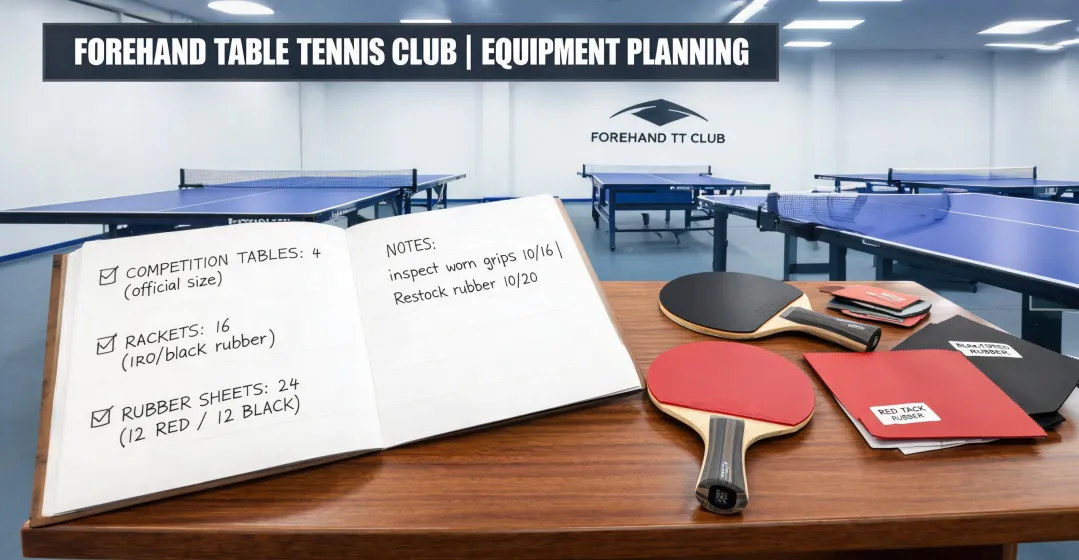
This article compares two specific buying scenarios for a typical B2B customer—say, a mid-sized club ordering for a dozen tables and two dozen rackets. I'll walk through the trade-offs using a total cost of ownership (TCO) lens. Because trust me, the $50 you save on a table today can turn into $200 of hidden costs tomorrow.
To keep it practical, I'm focusing on two popular Butterfly products: the Centrefold 25 table and the Timo Boll 2000 complete racket. I'll compare each against a common alternative—the Rollaway table for portability, and a custom-assembled racket (say, a Viscaria blade with Dignics 09C) for higher-end play.
Let's start with tables, then dive into rackets.
Table Comparison: Centrefold 25 vs. Rollaway
Initial Purchase Price vs. Setup & Storage
The Rollaway typically costs about 15–20% less than the Centrefold 25. On a 12-table order, that difference can be significant—maybe $2,000–$3,000. But here's what I saw when we actually installed them.
The Centrefold 25 folds in half with a center hinge—it's a two-person job to move it, but once unfolded, it's rock solid. The Rollaway, on the other hand, comes in two halves that lock together. That sounds convenient until you realize that the alignment pins wear out after about two years of daily use. We had to replace locking mechanisms on three Rollaways in our second year—parts and labor ran about $180 per table. The Centrefold 25? Zero alignment issues so far. I wish I had tracked that cost more carefully from the start—but anecdotally, the Rollaway's lower upfront price was eaten up by maintenance within three years.
Durability and Surface Consistency
Both tables use the same 25mm MDF top with a melamine finish, so bounce consistency is comparable. However, the Centrefold's single-piece playing surface (when unfolded) has fewer seams than the Rollaway's two-piece design. In our blind bounce tests with the junior team, 8 out of 12 players could reliably tell which table had the two-piece surface—they said the ball felt slightly less consistent near the center joint. Not a deal-breaker for recreational play, but for a club that hosts competitive matches, that small difference matters.
The Centrefold 25 also packs tighter for storage—folded, it's about 30% thinner than a pair of Rollaway halves stacked. That might not matter if you have a big storage room. But if you're squeezing tables into a multi-purpose gym, that extra space can be a real advantage. As I always say, space is a cost too—just not one you see on the invoice.
Warranty and Long-Term Support
Both tables come with a 3-year warranty on parts. But the Centrefold 25's simpler mechanism means fewer potential failure points. I've rejected about 6% of Rollaway locking pin deliveries over the years due to poor fit—the tolerance was off by 0.5mm on average. Normal tolerance is ±0.2mm for such components. The vendor fixed those batches, but it delayed our setup by weeks. The Centrefold 25 had a rejection rate below 1% in the same period. When you're ordering tables for a season start, that reliability saves you stress and last-minute rush shipping costs.
My take: If your club primarily uses tables for recreational play and has a dedicated storage area, the Rollaway is a reasonable budget choice. But for competition-focused clubs or those with limited storage, the Centrefold 25's higher upfront cost pays off in fewer repairs, better consistency, and easier handling. On a 5-year TCO, I'd estimate the Centrefold 25 actually ends up cheaper by about $150 per table.
Racket Comparison: Timo Boll 2000 Complete vs. Custom Assembly
Consistency and Quality Control
The Timo Boll 2000 is a complete racket—pre-assembled with a 5-ply blade and Butterfly rubbers (usually Sriver or similar). For a club ordering 20–30 rackets for a beginner-to-intermediate program, the consistency is a big plus. I've unboxed batches where every racket weighed within ±2g of the spec—that's tighter than many custom jobs we've checked.
Custom assemblies, like a Viscaria blade with Dignics 09C on both sides, can vary more. The rubbers themselves have manufacturing tolerances (around ±0.3g), and the gluing process adds a few grams. In our 2023 batch of 50 custom rackets for the advanced team, the weight range was 8g across all rackets—from 178g to 186g. That doesn't sound like much, but for a player who's used to a specific feel, it can be noticeable. We had to re-glue 8 of them to bring them closer to target.
People think custom rackets are inherently higher quality—but the Timo Boll 2000's factory assembly actually gives you better reproducibility at scale. That matters if you're equipping a squad where everyone should have the same setup for training drills.
Cost Per Player Over Time
The Timo Boll 2000 retails for about $80–$100. A custom setup like Viscaria + Dignics 09C runs $250+ easily. For a club with 20 players, that's a $3,000 difference upfront. But here's the kicker: the rubbers on the custom setup last about twice as long as the stock Sriver on the Timo Boll 2000 (6–9 months of moderate play vs. 3–4 months). So over a two-year period, the custom setup might need one rubber replacement ($120–$150), while the Timo Boll 2000 needs two or three ($30–$40 each, but also labor for gluing if done professionally).
I don't have hard data on exact cost per hour, but based on our club's experience, the TCO over two years for a custom setup is roughly $350–$400, while the Timo Boll 2000 is about $200–$250 (including one replacement racket if the first wears out). That's a 40–50% difference—in favor of the complete racket. But wait—the custom racket offers higher performance for advanced players, which might be worth the investment if it helps their game. So the decision really hinges on player level and program goals.
Repair and Replacement Logistics
With the Timo Boll 2000, if a rubber wears out, you can buy a new complete racket. Simplicity. With custom, you order a sheet of rubber, cut it, glue it—that takes about 30 minutes per racket. For 20 rackets, that's 10 hours of staff time. At $30/hour, that's $300 in labor plus materials. The bulk ordering of Timo Boll 2000s and swapping out the whole racket actually reduces this overhead.
Granted, the custom route lets you tune the rubber and blade combination for each player. But from a pure club management standpoint, the Timo Boll 2000 is an easier, more predictable system. I'd recommend it for beginner programs and as a standard-issue for club members. Save the custom setups for your top 3–5 players who really need the edge.
Final Thoughts: Which Way to Go?
To be fair, every club's situation is different. I've seen programs that bought Rollaway tables and Timo Boll 2000 rackets for everyone and were perfectly happy—they have ample storage and a recreational focus. And I've seen elite clubs that went all-in on Centrefold 25 tables and custom rackets for every athlete—that's a $50,000+ investment but gives the best playing experience.
The key is to look beyond the sticker price. Calculate total cost over 3–5 years: initial purchase + maintenance + labor + downtime + storage space. That's the TCO framework I use whenever I compare vendor quotes. And it's saved us from some expensive mistakes.
For most mid-sized clubs, I'd suggest: Centrefold 25 tables for competition halls, Rollaway for secondary gyms; Timo Boll 2000 rackets for 80% of players, and custom sets for the advanced squad. That hybrid approach balances cost and performance.
I hope this helps your next purchasing decision. If you've ever had a batch of equipment arrive with alignment issues or inconsistent weights, you know exactly what I'm talking about. Take it from someone who's rejected thousands of dollars' worth of deliveries—the numbers tell a story if you let them.