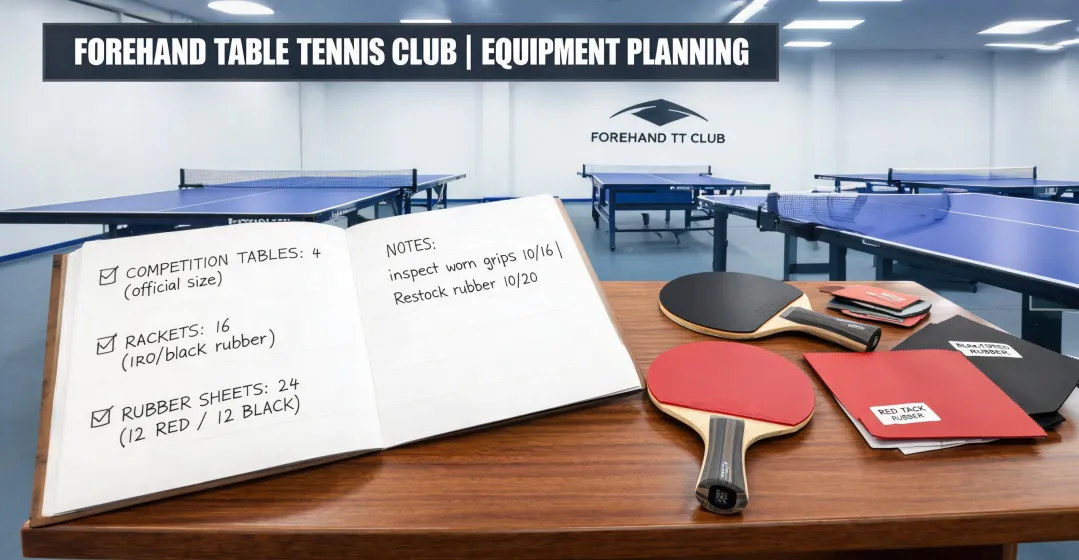
I coordinate equipment for a regional table tennis club. When a player shows up 36 hours before a tournament with a torn rubber, I'm the one who decides what gets glued on. In March 2024, one of our juniors found a bubble in his Tenergy 05 before a Saturday qualifier. Had two days to decide. Normally I'd spend a week testing a rubber, but there was no time. Missing that deadline would have meant him playing with a rubber he didn't trust. That emergency forced me to answer the question every club manager eventually faces: Dignics 09C or Tenergy 05?
Most Butterfly Dignics 09C table tennis rubber reviews focus on the short game, and for good reason. But this comparison is not a generic 'both are good' review. I'm going to compare them the way I actually compare them in my inventory spreadsheet: short game, open-power loops, longevity, and cost-per-racket. If you're a player or a club buyer, this will tell you which side of the line you fall on.
Why These Two Are the Right Comparison
Butterfly introduced Dignics as a separate line from Tenergy, but in practical terms, Dignics 09C is the rubber buyers compare directly to Tenergy 05. When players search for 'table tennis butterfly' rubbers, they almost always end up comparing these two. They share the same price tier and the same tensioned-sponge concept. The key difference is response: Tenergy 05 uses a soft, springy sponge that gives you catapult on every swing. Dignics 09C uses a harder sponge and a more linear response curve.
So the comparison is not just 09C vs. 05. It's an older style of speed vs. a newer style of control. To make it useful, I'll keep it to the four things that actually decide a setup.
Dimension 1: Short Game and Serve Receive
If you believe the marketing, you'd expect Dignics 09C to be a short-game monster. In practice, it is—but not for everyone. The harder sponge gives you a direct, less bouncy response on soft touches. Pushes sit shorter. Receive against a fast spin-heavy serve is easier to keep low. When I put the 09C on a player's backhand for the first time, their reaction was 'it feels dead at the table.' That's not a criticism. That's exactly what you want when someone loads you with heavy spin.
Tenergy 05 feels livelier by comparison. It's more forgiving on loose swings because the sponge absorbs and returns more energy. But it's also easier to overshoot a short push or pop up a heavy backspin serve. Everything I'd read about hard rubbers said they were automatically harder to control. In practice, the 09C's hard sponge actually gives you more spin control in the short game because it won't spring the ball off the blade the way Tenergy's soft tension does.
Conclusion: Dignics 09C wins this dimension for players with active contact. Tenergy 05 is easier for players who rely on the sponge to do the work.
Dimension 2: Looping and Mid-Distance Power
There is an old idea that 'hard rubber equals fast rubber.' That thinking comes from the era before modern high-tension sponges. Tenergy 05 with its softer sponge is actually faster on a full-loop swing than many harder rubbers. Dignics 09C is not about raw speed. It's about spin-with-speed on demand.
Here's the thing: on a full-swing loop from mid-distance, Tenergy 05 still has an edge in raw arc and brute power. If you win points by out-rallying opponents a meter behind the table, Tenergy's catapult effect matters. Dignics 09C's linear response means it doesn't feel like it's doing the work for you. You have to put more acceleration into the swing. Once you do, the spin-to-speed ratio is outstanding. The ball dives but doesn't fly long as often. Our coaches call it 'a rubber that rewards technique, not just contact.'
Conclusion: Tenergy 05 wins on raw distance power and easier looper-friendly feel. Dignics 09C wins on spin-driven aggressive shots when there isn't room for a full swing.
Dimension 3: Durability and Consistency Over Time
Online reviews tend to get vague here—'Tenergy lasts a couple months' or 'Dignics wears faster' without data. It took me about three years and 200 fitted rubbers to understand that the real durability question is the sponge, not the surface. Our club logs every rubber we fit and when it gets replaced. Here is what our numbers say:
- Tenergy 05 stays in first-choice condition for 35–45 hours of regular training in our junior program.
- Dignics 09C starts to lose spin consistency around the 40-hour mark, but the hard sponge keeps the rubber playable longer.
- Surface durability is similar. The real difference is the sponge. Tenergy 05's soft tension loses its spring earlier. 09C's harder sponge hangs on.
There is a caveat: Dignics 09C is more sensitive to a dirty surface because its spin comes partly from slight tackiness. If players don't clean rubbers after every session, the 09C will feel dead in a month. Tenergy 05 is less punishing because its spin comes from the sponge, not the surface.
Conclusion: Dignics 09C has a longer useful life for disciplined players; Tenergy 05 is more forgiving if maintenance is poor.
Dimension 4: Price and Club Buying Realities
As of January 2025, both rubbers sit in the premium tier. On our last bulk order, Dignics 09C was about five dollars more per rubber than Tenergy 05. You can verify current pricing on Butterfly's authorized dealer list or the ITTF Authorized Rubbers list. Butterfly rubbers in this review carry the ITTF logo shown on that list, which follows the requirements in ITTF Technical Leaflet T3.
Price is not the main factor if you're outfitting one match racket. It matters when you buy for a club with 15 players. Five dollars extra per rubber, across two wings per player, is 150 dollars. That's real. Rozena, at about half the price, is our practice rubber. Dignics and Tenergy are for match rackets.
Which One Should You Choose?
Look, I'm not going to tell you Dignics 09C is the best rubber for everyone. I recommend it if you're an intermediate or advanced player who contacts the ball actively, receives a lot of spin with a short push, or uses a backhand flick to open. I also recommend it for clubs with a consistent cleaning routine.
Skip Dignics 09C and stay with Tenergy 05 if you depend on the rubber's elasticity to generate loop power, if you favor mid-distance rallies, or if you can't trust players to wipe their rubbers after every session. There's no shame in that. Tenergy 05 became a legend for a reason. It's still the safer choice for most all-around players.
Here is the decision framework I put in our club spreadsheet:
- Short game and serve receive are your priority → Dignics 09C.
- You want an easier, consistent arc on full swings → Tenergy 05.
- You're buying for a junior academy with disciplined players → Dignics 09C if budget allows.
- You're outfitting a school hall where rubbers get abused → Rozena or Tenergy 05 on the forehand and save the money.
No rubber is 'better' outside a context. The best decision matches the player's stroke, the club's maintenance culture, and the tournament schedule. My March 2024 emergency setup? I put Dignics 09C on the junior's backhand and kept Tenergy 05 on the forehand. He won his opener 4–1. That didn't prove 09C is right for everyone. It proved that, for that particular player, on that particular day, the slower short game was exactly what he needed.
Prices referenced as of January 2025. Verify current pricing with the Butterfly authorized dealer list and the current ITTF authorized rubbers list before ordering in bulk.