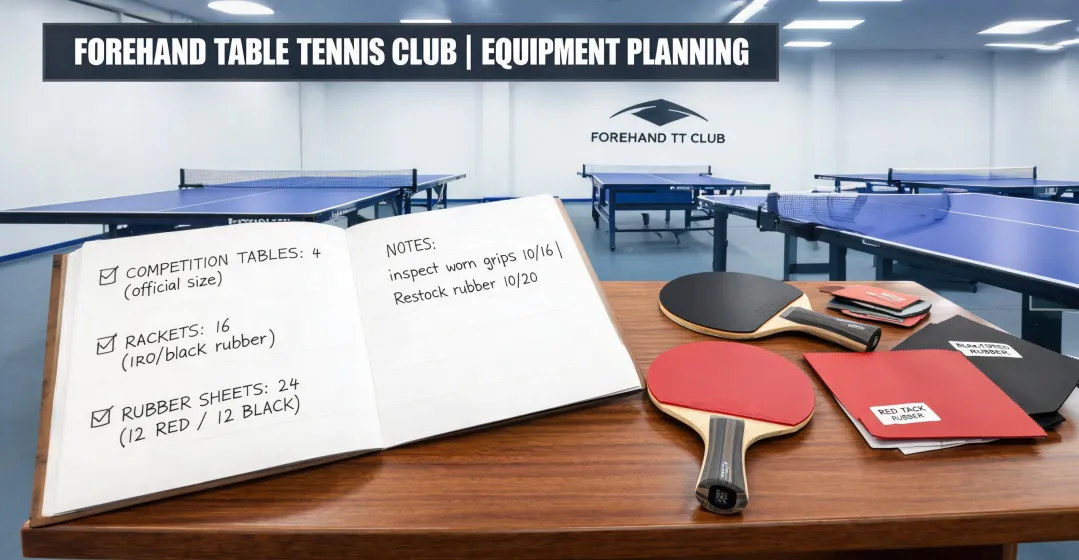
If you're looking at table tennis tables for a fitness club, school, or rec center, the two main paths are pretty clear: invest in a premium brand like Butterfly, or go with a more budget-friendly option. I've been on both sides of this decision as an office administrator managing equipment orders for our facilities — and it's not as simple as "buy cheap, replace often." So, I want to break down the real cost and experience difference, dimension by dimension.
The Core Question: What Are You Actually Buying?
The first thing to understand is that you're not just buying a slab of wood on legs. You're buying a package of durability, playability, and — most importantly for someone in my role — administrative hassle. A cheap table might save you $200–$500 upfront, but the hidden costs in repairs, complaints, and replacement can eat that up fast.
To be fair, not every situation calls for a premium table. A church youth group that uses it once a week might be fine with something basic. But for a high-traffic commercial setting? I'd argue the math flips. Here's the breakdown.
Dimension 1: Build Quality & Longevity — The 3-Year vs. 10-Year Table
Butterfly tables are built on a metal frame with thicker, high-density MDF or composite tops. Their outdoor rollaway tables, like the Butterfly Drive Roller, have weather-resistant coatings and reinforced corners. The folding mechanism is smooth and locks firmly — no wobbling. In my experience, a Butterfly table in a moderate-use commercial setting (say, a school gym used 5–6 hours daily) will easily last 8–12 years with basic maintenance.
Generic/budget tables typically use thinner particleboard and thinner metal tubing. The folding hinges are often weaker. After about 18–24 months of daily use, I've seen the playing surface begin to warp (especially if stored near a window or in a humid space), the net brackets break, and the legs start to wobble. In one instance, a budget table lasted barely 18 months before the playing surface cracked near the center fold — a $400 repair on a $600 table.
The contrast is stark: You can buy one Butterfly table for roughly $900–$1,400 (depending on model), or you can buy three $350 tables over a decade — and still end up with more downtime, more complaints from users, and more admin time spent processing a warranty claim or ordering replacement parts. I've seen this pattern multiple times. The math usually doesn't favor the budget option in high-use commercial settings.
Dimension 2: Playability & User Experience — The “Fun Factor”
This one surprised me when I first started managing our recreation equipment. I assumed that for casual play, any table would do. I was wrong.
Butterfly tables are designed to professional bounce standards (ITTF-approved). The ball bounces consistently from one end to the other. The surface is matte and uniform. Even an intermediate player can tell the difference immediately — the ball responds predictably, which makes the game more enjoyable. Our club members started noticing within weeks that the newer Butterfly tables felt “better” than the older budget ones we had. Fewer complaints about dead spots or uneven bounce.
Generic tables often have variable surface quality. Budget tables may have visible seams, a slight orange-peel texture on the paint, or inconsistent thickness. The ball can behave unpredictably — bouncing lower in one corner, higher in another. I remember a member saying, "It feels like I'm playing on a different table every time I move two feet." That's a direct complaint I've heard multiple times. It takes the fun out of the game.
Why this matters for an admin buyer: User satisfaction directly translates to lower maintenance requests, fewer complaints to your desk, and higher utilization of the equipment. If people don't enjoy using the table, they'll stop using it — or worse, complain to their supervisor about the quality of the facility.
Dimension 3: Total Cost of Ownership (TCO) — The Hidden Numbers
This is where the comparison gets really concrete. Let's look at a 5-year TCO for a single table in a high-traffic commercial setting (say, a university rec center).
Butterfly Table (e.g., Drive Roller): ~$1,200
- Purchase cost: $1,200
- Maintenance over 5 years: ~$75 (replacement net set, occasional cleaning)
- Parts replacement probability: Low. I've had to order exactly one net clamp in five years.
- Expected lifespan: 8–12 years
- 5-year cost: ~$1,275
- Residual value after 5 years: ~$500–$700 (they hold value well if maintained)
Generic Table: ~$400
- Purchase cost: $400
- Maintenance over 5 years: ~$150 (frequent net issues, replacement brackets, surface touch-up)
- Parts replacement probability: High. Hinges fail. Net posts bend. Surface chips.
- Expected lifespan: 2–3 years
- 5-year cost: $400 + $150 + likely replacement at year 3 ($400) + second maintenance = ~$1,000–$1,100
- Residual value after 5 years: ~$50–$100 (if it's even still functional)
The numbers are closer than you'd think. Over 5 years, the Butterfly table costs about $200–$300 more — but you get a better experience, fewer complaints, less admin time, and a piece of equipment that still has significant value. That $200–$300 difference is less than the cost of one service call from a technician to fix a broken hinge on the generic table.
What To Choose — Scenarios
Choose Butterfly if:
- Your table will be used daily (schools, clubs, rec centers).
- You care about user experience and want fewer complaints.
- You have budget flexibility upfront.
- You want a table that will hold value for resale or transfer.
Choose a generic table if:
- Usage is very low — once a week or less (multi-purpose room in a church, occasional family use).
- Budget is severely constrained and you cannot allocate $900+.
- The table will be used by children or very casual players who won't notice uneven bounce.
- You're okay with replacing it in 2–3 years.
Final Take
I've learned through experience that the absolute lowest purchase price is not the same as the lowest total cost. The hidden costs of a cheap table — in repairs, user dissatisfaction, and admin time — often outweigh any upfront savings. Butterfly tables are not cheap, but they are rarely a bad investment for a commercial setting.
That said, I get it — budgets are real. If you must go with a budget option, at least buy from a supplier that offers replacement parts and has a clear return policy. I learned that lesson the hard way when a $300 table broke 14 months in and the vendor told me to ship it back at my own cost. The shipping quote was $180. That table ended up in the dumpster.
In short: know your usage, calculate the real cost over 5 years, and decide based on that — not just the sticker price.