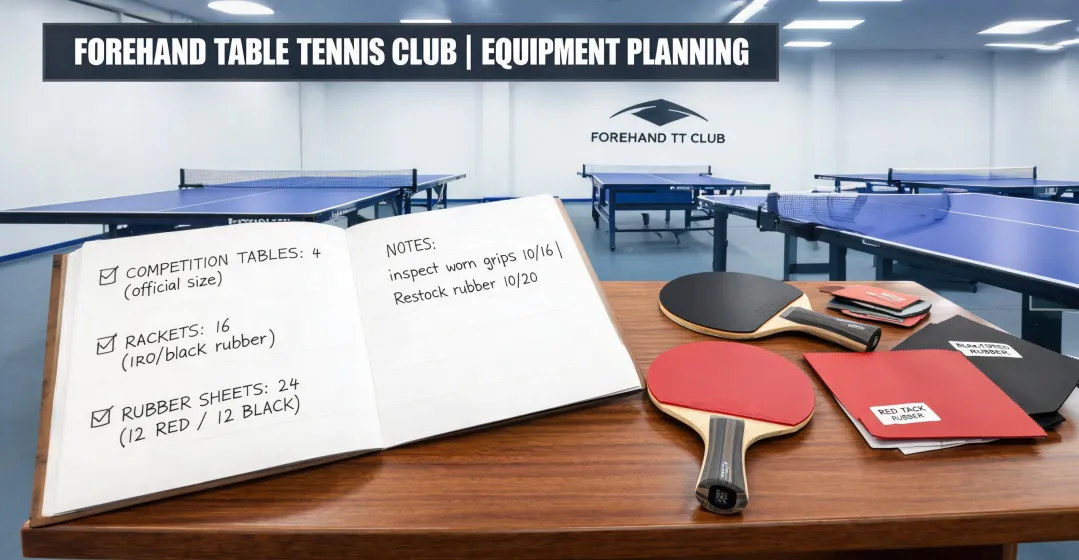
In 2024, I had to replace seventeen table tennis rackets at our community sports center. Not because they were worn out, but because players kept bringing them back with rubber peeling off the blade, chipped edges, and the same complaint: 'the bounce feels dead.' My first reaction was to blame the products. My second reaction was to blame the budget. Both were wrong.
I manage purchasing for a municipal sports center. Roughly $80,000 a year in equipment orders crosses my desk, from strength room flooring to locker room signage. I report to operations and finance, which means I care about both invoices and outcomes. When I took over in 2020, I thought table tennis was one of the easier categories. A paddle, a ball, a table. What could go wrong? A lot, it turns out.
The Problem I Thought I Was Solving
The complaint log said 'paddles are bad.' We had tested a $9 store racket and a $25 recreational set. Both produced the same complaints. So I did what most buyers in my position do: I asked for a lower price on something a little better. That strategy failed for three years.
By late 2023, replacement paddles and emergency rubber orders had cost us about $3,800. Maybe $4,100; I'd have to check the spreadsheet. The exact number doesn't matter. What matters is the number kept going up while the complaints stayed the same.
I knew I should have tested a sample pack before ordering fifty rackets for the summer program, but I thought, 'what are the odds that a racket is actually defective?' The odds caught up with me. We lost a week waiting for replacement stock before the youth league started.
The Real Problem Was Invisible on the Quote
The turning point came when a table tennis coach walked through the facility and pointed at how players were holding their paddles. She said, 'How to hold a ping pong paddle is the first lesson. Half of the players here are using a grip that makes the rubber's job impossible.'
That phrase stayed with me. I had been comparing prices, not usage. The deeper issue wasn't durability. It was that we bought equipment without thinking about player skill, training, or the actual demands of a multipurpose facility. A stiff blade with an unresponsive rubber can make a developing player look worse than they are. A good blade in the wrong hands gets blamed for every missed spin.
I noticed the same pattern in the weight room. We replaced barbells twice because members said the knurling was too sharp. A trainer finally told me that one member's barbell squat form was the actual problem. The bar was fine. We didn't need a new bar; we needed two sessions on movement mechanics. In table tennis, a grip problem is a movement problem. No rubber can fix it.
The pool area taught the same lesson. I compared quote after quote for a pool slide and chose the lower-priced model because it looked identical in the brochure. The lead time put delivery after spring break, so we rented an inflatable slide for two weekends. The rental erased the savings. The total cost of a pool slide is not the slide. It's the opening weekends you lose while the new one sits in a warehouse.
When I finally compared a $12 racket and a Butterfly Viscaria table tennis blade side by side, I understood why our players kept failing. The cheap blade feels stiff and hollow. The Viscaria, which I learned about from a Butterfly Viscaria table tennis blade review, has a five-ply wood core and ALC carbon layers. It gives feedback instead of hiding mistakes. Players need that feedback to learn. If the racket feels like a brick, they compensate by gripping harder, which only makes the problem worse.
I'm not saying Butterfly table tennis equipment is always the answer. I'm saying the decision framework has to change first.
What Inaction Actually Cost
Let's make this concrete. In 2022, we ordered forty low-cost rackets for a youth program. They arrived on time, but by week two, six rubbers were separating from the blades. We spent $180 on glue and regluing, then another $220 on replacements, then two staff hours per week on complaints. That's not a $12 racket cost. That's a $500 program cost, plus a less visible cost: kids left the program thinking table tennis was slow and frustrating.
In my experience managing 60–80 orders a year, the lower-priced quote has cost us more in about sixty percent of cases. I don't have a peer-reviewed study to cite. I have purchase orders, vendor invoices, and a spreadsheet full of reorders. The hidden costs show up in emergency shipping, staff time, and lost programming.
Honestly, I'm not sure why so many facilities still choose by sticker price. My best guess is it's easier to defend a low number on a purchase order than to explain lifecycle cost to finance. But finance notices when the same line item appears four times in a year.
What I'd Do Differently, Briefly
The fix isn't to buy expensive equipment and call it a day. It's to change the question from 'how much does this cost?' to 'what will this cost us over two years?'
- Buy components, not mystery sets. If the players in your facility are past the once-a-month stage, choose a medium-control blade and a semi-soft rubber that gives them a chance to develop. Per ITTF equipment regulations (as of January 2025), an approved racket covering must be red on one side and black on the other, and approved rubbers carry an ITTF code. That code is a useful starting point for a purchasing conversation.
- Invest in practice tools. A Butterfly Amicus Prime table tennis robot is not a small purchase, but it solved a problem we kept ignoring: players couldn't practice without a partner. Once the robot fed consistent balls, players could finally see that their grip, not the racket, was causing the inconsistency.
- Teach the grip. Put a simple sign or a short video loop near the table that shows how to hold a ping pong paddle. It sounds too simple, but it cut our smashed-paddle incidents and actually made players feel more confident.
- Track total cost, not PO price. Include reorders, glue, tape, staff time, and lost playing time. That's the number that should drive the next order.
This worked for us, but our situation was a municipal facility with open play and lots of beginners. If you're running a competitive club or a school team with a budget that resets every August, the products and price points will be different. The principle won't be.