Every week, someone forwards me a Butterfly elite table tennis clip and asks whether we should order the same setup for our players. After nine years of handling equipment purchasing for a 200-player table tennis center, I can tell you the answer depends more on the club's situation than on the equipment itself.
I am responsible for our Butterfly orders, and I have personally made (and documented) 11 significant buying mistakes, totaling roughly $14,000 in wasted budget. The worst of them was a $3,200 order in September 2022. I now maintain the checklist our coaches use before every purchase, because I do not want anyone else to repeat my errors. If you buy blades and rubber for a club, school, or small federation, this article is the decision path I wish I had at the start.
In my experience, every equipment request falls into one of three situations:
- A starter or junior program still building fundamental strokes.
- A competitive squad that trains consistently and enters tournaments.
- A multi-level social center or school with many different playing standards.
Each situation deserves a different answer. These are the differences that matter.
Situation one: Starter and junior programs
This is where I made my most expensive mistake. In 2017, my first year in this role, our junior summer camp was growing quickly. Parents kept asking whether their children would get 'real' Butterfly equipment, so I translated that as 'buy the best in the catalog.' I approved 14 Viscaria blades and 28 sheets of Tenergy 05 for players aged eight to thirteen.
I knew I should have checked their actual playing level first, but I thought: what are the odds that premium equipment hurts a beginner? That was the one time it mattered. The setups were too fast and too sensitive for developing strokes. Ball quality got worse, not better, and several children started compensating by tightening their arms to hold the ball on the table.
The expensive racket was the wrong racket. It did not make anyone faster; it delayed exactly the skills we were trying to build.
The invoice was about $4,800 — maybe a little more, I would have to check the ledger. We replaced those setups with controlled five-ply all-wood blades such as the Butterfly Primorac or Korbel, paired with one dependable rubber family such as Sriver or Rozena. For a starter program, simplicity is a feature: one blade model, one rubber model, and one standard sponge thickness keeps inventory small and replacement costs predictable.
Players at this stage need feedback from the ball, not raw speed. A clean hit with an all-wood blade sounds and feels different from a mistimed one. That feedback teaches consistency. A fast composite blade with a high-performance rubber masks those mistakes, and the player never learns what clean contact actually means.
Situation two: Competitive squads with real training hours
Once players train eight or more hours per week and compete regularly, premium Butterfly table tennis equipment belongs in the conversation. This is where composite blades such as the Viscaria or Timo Boll ALC and rubbers from the Tenergy or Dignics families make sense. The trap at this level is treating the entire squad as one player.
In September 2022 I submitted a $3,200 order for our under-15 squad's rubber. I had confirmed the product family verbally with the coach and approved the purchase order without checking the written specification columns. The sponge thickness defaulted to a version that squad does not use. All 40 sheets arrived wrong, and we lost two weeks of preparation time waiting for the correct replacement.
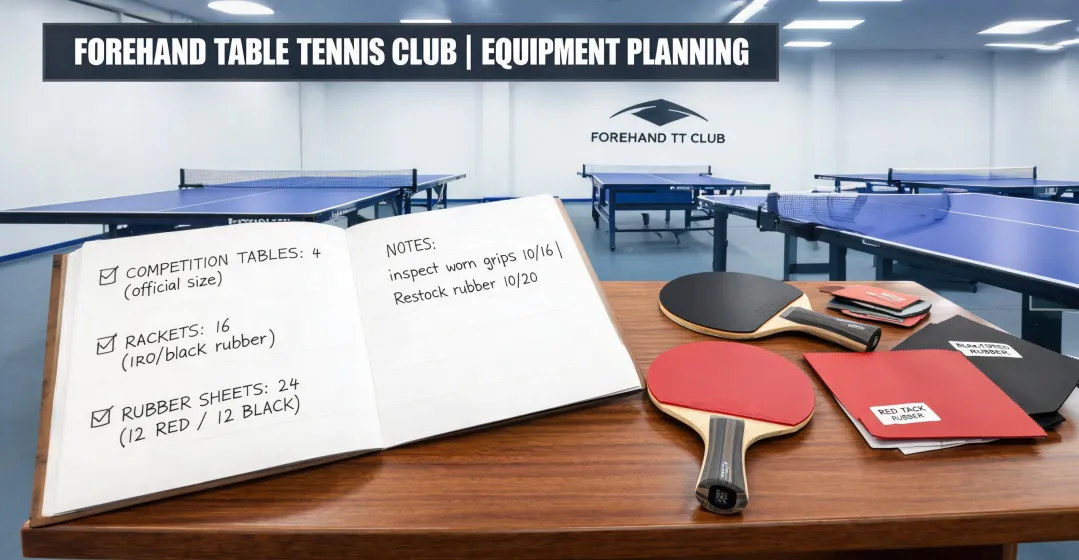
That experience created our rule: if it is not written in the purchase order, the order is not confirmed. Every competitive player now has a specification line listing the blade model, handle shape (FL, ST, or AN where available), rubber model, sponge thickness, and forehand/backhand colors.
Putting these specifications into one shared digital sheet felt like unnecessary administration at first. In reality, it cut our equipment turnaround from about five days to two days and removed the data-entry mistakes we used to have. Since Q1 2024, our checklist has caught 47 potential errors before any money moved. That is what efficiency looks like in an equipment room.
A few practical notes for this level:
- Do not order the same composite blade for every squad member. Use a baseline such as Viscaria or Timo Boll ALC, then let each player test with the club's robot before the order is placed.
- If a player asks for a professional's exact setup after watching a Butterfly elite table tennis clip, treat it as a trial request, not as a purchase order.
- The blade is the long-term asset. A competition player can keep the same Viscaria for years and change rubbers as technique evolves. Test the rubber on the player's own blade before committing to a batch.
We use an Amicus Prime robot for these tests. Setting the same drill for every player, such as backspin to loop, gives us a comparable read on arc and consistency, which is more useful than 'it felt good for five minutes.'
Situation three: Multi-level social centers and schools
Situation three looks straightforward, but it creates the messiest inventory. A social center may have a few adult regulars, an after-school class, and one small league team. If you let every group order what it wants, you end up with a storeroom full of one-off purchases. By the end of 2022, we counted 14 different rubber variants in our shelves. That is not flexibility; that is money sitting still.
We replaced the free-for-all with a three-tier purchasing list:
- Foundation: an all-wood blade such as the Primorac or Korbel with Sriver or Rozena. This covers beginners and casual social play.
- Advanced: a composite blade such as the Viscaria or Timo Boll ALC with Tenergy 05. This is for local league players who train consistently.
- Competition: players at regional level or above receive an individual written specification, usually from the Dignics or Tenergy families. This tier is never a walk-up purchase.
If someone wants to go outside the list, they have to justify the exception in writing. That small rule removed most of the expensive impulse buying from our process.
One more warning from my own record. In 2020, we saved about $1,100 by ordering 14 blades from an unverified online listing instead of from our authorized distributor. The package had no internal reinforcement, four blades arrived with damaged edges or surface plies, and the seller refused a return. Replacing those four at regular dealer pricing plus expedited shipping cost us $1,370. The saving disappeared and we still lost two weeks of preparation time.
For B2B use, authenticity and warranty support are not optional extras. They are the difference between planning a season and reacting to a crisis.
How to tell which situation you are in
You do not need a complicated survey. Look at the last two months of training and at the next season's calendar.
- If your group is mostly under 13, trains fewer than six hours per week, and has no tournament schedule, treat it as situation one.
- If your players train more than eight hours per week and compete at least monthly, treat it as situation two.
- If you have a mix of social adults, after-school beginners, and one league team with no full-time head coach, use the three-tier list from situation three.
The specifics above fit our situation: one indoor center, about 200 active players, and a shared storage room. If you are a school that orders once a year or a distributor managing multiple club accounts, the quantities will change, but the principle will not: label the spec, write it down, and route exceptions through a named person.
One bridge case: if you are in situation three but your league team is improving quickly, upgrade only that team, not the whole facility. Move the league team to the advanced tier and leave the rest on the foundation tier. This lets your budget support the players who are actually ready, without turning every casual session into a lab experiment.
A professional highlight video can make every racket look like the obvious choice. It is not the racket that matters first; it is the situation. Choose the situation honestly, write down the specification, and make the checklist part of your routine. Those steps turned my equipment ordering from a $14,000 source of stress into a quiet, repeatable process.