Speaking plainly: cheap table tennis equipment is the most expensive mistake a club can make. I'm not saying that as a salesman. I'm saying it as someone who has coordinated 200+ equipment orders for schools, clubs, and teams—most of them under genuine deadline pressure. Tournament dates don't move. Club seasons don't wait. And when gear dies a day before the event, you find out what "saving money" actually cost you.
My role is basically crisis management for table tennis gear. Coaches reach out when an order hasn't arrived, when a budget batch of rackets warped after two months, or when players show up with cracked blades a week before regionals. I've triaged enough emergencies to see the same pattern repeat: cheap upfront, expensive in every way that matters later.
The Butterfly Viscaria: Worth It, and Here's the Math
Take the Butterfly Viscaria table tennis blade. The price tag makes people hesitate—typically $180 to $220 depending on the retailer (based on major table tennis retailer listings, January 2025; verify current pricing). I've had club managers show me a $55 alternative and ask what the Viscaria actually gives them.
Here's my answer: a design from 2008 that's still used at the world-class level isn't hype, it's proof. The Arylate-Carbon layer in Butterfly's construction gives the blade a flex that players describe as honest. Not everyone can articulate what that means, but every player who has hit with a genuine Viscaria feels it. The blade responds predictably to the same stroke, every time.
In March 2024, a club called me at 4:30 PM on a Thursday. Their district tournament started the following Saturday morning, and three junior players had snapped their blades during a heavy training session. Not a wear-and-tear issue—just budget frames that gave out under pressure. Normal delivery for a Viscaria is five to seven days. We found a distributor who could overnight them, paid $60 extra in express shipping, and got the blades to the venue at 9 AM Saturday. The tournament started at 10.
The alternative was sending those kids into a knockout tournament with mismatched bats. If you've ever seen a player lose a match because their equipment stopped responding, you know that's not a fair contest.
But the long-term math is the real story. Those same Viscaria blades are still in service in 2025. The earlier batch of discounted blades the club bought to "stretch the budget"? Forty percent failure rate over two seasons. One cracked. Two delaminated. Another lost so much grip that players developed awkward compensations in their strokes. Replacing them cost more than the original savings. And those players had to unlearn habits built on unreliable equipment.
Not everyone needs a Viscaria. I'd never claim that. But when a blade has to perform—under lights, against an opponent who will punish every weakness—a $55 "saving" evaporates instantly.
The Addoy 3000 and the Beginner's Trap
The Butterfly Addoy 3000 table tennis racket is my favorite example of value thinking because it sits at the entry level. It's a complete racket, aimed at beginners and improving players, and it costs meaningfully more than the anonymous $15 sets you find on marketplaces.
I get why that gap feels hard to justify when money is tight. But I've watched what budget rackets actually do in school programs.
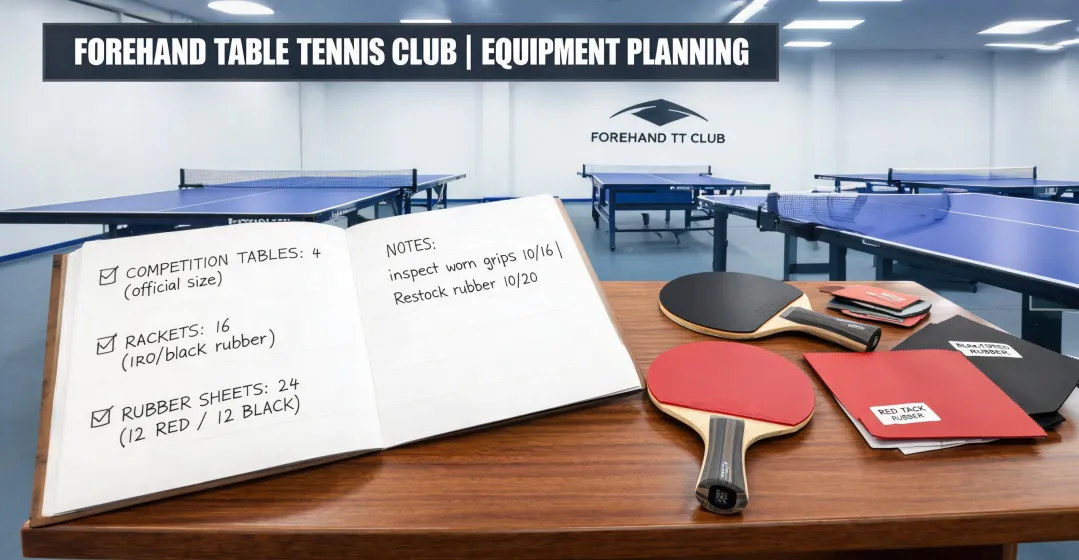
Last year, a school bought 24 cheap rackets to start a lunchtime club. The frames were okay at first—nothing great, but functional. By the end of the first term, seven had loose handles. Two had head shake. The surprise wasn't that they failed. It was how fast.
The school eventually replaced them with 12 Addoy 3000 rackets (retail around $60–$90 based on major retailer listings, January 2025). Modest spec, but a completely different manufacturing standard: straight-grained wood, balanced weight, Butterfly rubber that grips consistently. The difference isn't subtle. A beginner can finally feel what contact does to spin and speed. On a dead $15 racket, they learn a "technique" that makes no sense on decent equipment—muscling the ball, overcompensating with the wrist.
Fixing those habits later takes coaching hours. And in my experience, coaching time is far more expensive than the price difference between a $15 racket and an Addoy 3000.
In my first year doing this, I made the classic newbie mistake: I bought the cheapest paddles that looked fine in photos, to stretch a tight club budget. Took me one weekend of re-arranging logistics after 11 of 20 developed loose grips within two months. The facility manager said something I still think about:
"Every dollar you save, I pay later."
That's when I started calculating total cost instead of sticker price.
Spin Physics: Table Tennis vs. Bowling
Something interesting is how often people search "how to spin a bowling ball." Table tennis players search "how to spin a ping pong ball." The principles overlap more than most people realize.
Spin isn't magic. It's surface friction. A bowling ball hooks because the coverstock grabs the lane at an angle. A table tennis rubber generates spin because the topsheet grips the ball. Both require a surface that actually does its job.
You can't learn to hook a bowling ball if the ball's surface has no grip. And you can't learn to spin a table tennis ball with rubber that's slick as glass. Watch any "how to spin a bowling ball" tutorial and you'll hear the same advice: the ball's surface matters as much as the throw. Table tennis is no different—the rubber's grip is the actual mechanism. Trying to "brush" the ball with dead rubber doesn't teach you anything except frustration.
I once spent three hours watching a junior player fail over and over to get spin, convinced she was doing something wrong. She wasn't. The rubber was worn out. New rubber on the same blade, and the same stroke worked immediately. No magic involved—the equipment was the variable.
Off-Table Training and the Focus Paradox
Players do so much work off the table. They go to the gym, do dumbbell arm exercises to build forearm strength for heavier topspin. Good—forearm development is genuinely useful in table tennis.
But here's the bottleneck: if the rubber can't grip, extra strength just makes the shot worse. You can curl all day; the ball doesn't care how strong your arm is when the paddle surface is dead. The equipment limits what your training can express.
And the contrast kills me: players will spend $250 on Bose earbuds to block out distractions during practice, buy proper shoes, eat clean, warm up correctly—then play with a paddle that undermines all of it. Focus is brilliant. Concentration matters. But no noise-cancelling tech on Earth fixes rubber that doesn't bite.
The third time I saw a club order the same failing budget rackets, I finally created a procurement checklist. Specs, warranty, replacement lead time, realistic lifespan. Nothing fancy. I should have done it after the first time.
To the Budget Objection
"We don't have the budget"—I hear it constantly, and to be fair, it's real. When you need 40 rackets for a PE program, the price difference matters. Fine. Make that decision consciously. Choose based on total cost per season, not per unit.
And the common argument that beginners just need something to start with? I understand the impulse. But the starting phase is precisely when players build movement patterns. Learning on equipment that lies to you is like learning to drive in a car with a loose steering column. You'll learn—how to overcompensate.
Granted, I'm not saying only Butterfly equipment is acceptable. That would be silly. The principle isn't "premium or nothing"; it's "calculate honestly." Use whatever brand works for you, but don't pretend the sticker price is the only number that matters.
Bottom line: cheap table tennis gear is a false economy. Across 200+ rush orders, the same lesson keeps repeating. The Butterfly Viscaria's durability pays for itself over years of hard play. The Addoy 3000 gives beginners a foundation that avoids costly re-training later. Spin depends on quality surfaces, just like bowling. And all the off-table discipline—the dumbbell arm exercises, the focus sessions with Bose earbuds—means nothing if the paddle can't translate effort into controlled shots.
There's genuine satisfaction in a well-executed rush order. I'm not going to pretend otherwise. But the best outcome is never needing that rush delivery in the first place. Value over price. Every time. That's not a slogan. It's what I've learned the hard way.