The order that started it
Last spring, I rejected twenty-four sheets of rubber that looked perfect to everyone except me.
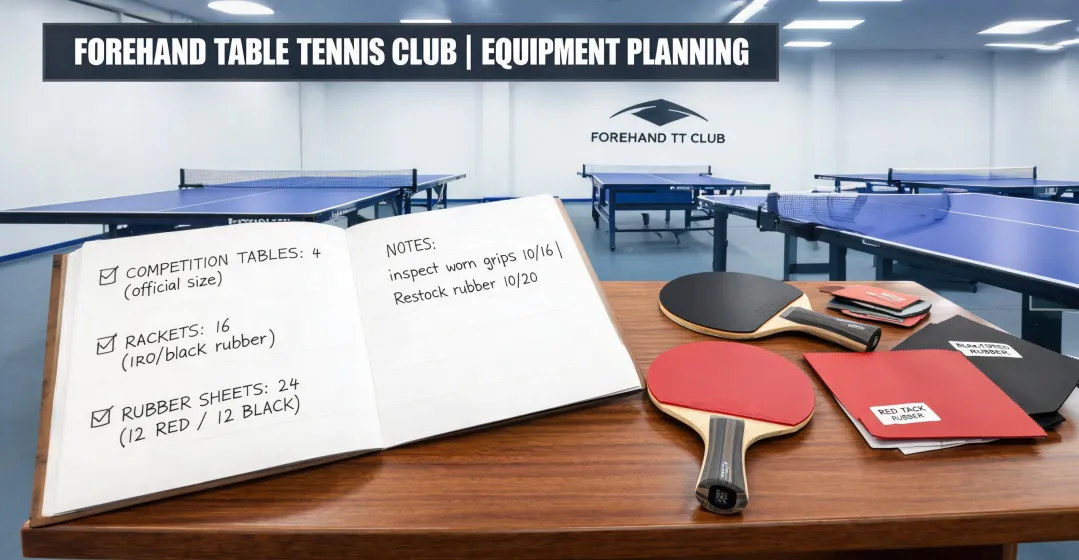
The sheets were Butterfly Rozena, 2.1mm, black and red, sealed in the usual packaging. The logos were centered. The plastic was intact. But when I ran the thickness gauge across the sponge, the edge readings were off by almost 0.05mm from the center. On a normal day, that difference might not change a match. On a training table with twenty-four rackets, it changes the way a kid learns to feel the ball. A rubber that feels uneven in the hand creates a kid who compensates with a weird stroke. That's not something a review photo will show you.
I'm a quality and brand compliance manager at Butterfly Table Tennis. I review a lot of product before it ships—roughly 500 units a week during peak season. In 2024, I rejected about 1.8% of first deliveries. Most issues are minor: packaging creases, uneven sponge, logo registration. But this Rozena batch was the kind of issue that doesn't show up in a photo. It only shows up after a week of play, when the coach starts putting tape on the edges and wondering why some kids hit the ball differently.
Those sheets were part of an order for a youth training center. The director wanted to replace old paddles with something durable and consistent. She asked me why Rozena kept showing up in her searches for 'butterfly rozena table tennis rubber reviews.' I told her it's not because Rozena is the fastest or spinniest rubber. It's because it's forgiving. Players who are still learning to contact the ball can get more margin for error. That matters more than a few km/h of ball speed. The point of a review is to tell you what a product does under real conditions, not what it claims on a box.
What people miss about Rozena
There's a temptation to treat rubber selection like a spec-sheet argument. It's tempting to think you can compare speed and spin numbers and pick the winner. But the blade, the sponge hardness, the player's technique, and even the balls they use all change the result. The 'more expensive rubber is better' advice ignores that a racket is a system, not a single part. I've had players try a loaner racket with Rozena and swear it was slower than their old rubber. Then they checked the blade and realized the blade was five-ply all-round, not carbon. Same rubber. Different system.
Here's something vendors don't always tell you: rubber thickness varies slightly by batch. A sheet listed as 2.1mm might be 2.08mm on one edge and 2.12mm on the other. Individually, that's fine. But when a club orders twenty-four matching rubbers, they need the same batch. Otherwise, half the paddles feel dead and half feel lively. That split has caused more refunds than actual defects. It also creates a hidden problem in team training: players start to compare equipment instead of focusing on their footwork.
For the training center order, Rozena made sense because of consistency, not peak performance. I've read a lot of user comments on it, and the word that comes up again and again is 'predictable.' That's what a coach wants. Predictability is a feature, even if it doesn't look exciting in a review. The same goes for the assembled paddles we eventually recommended: a reliable setup beats an impressive one when you're buying for a group of developing players.
Paddles are systems, not parts
When people search for butterfly table tennis paddles, they expect a certain level of consistency. That's fair. But consistency alone isn't enough. The paddle has to match the player. A carbon blade with Tenergy 05 is a brilliant setup for someone who can control it. For a ten-year-old who is still working on basic contact, a softer all-round blade with Rozena is a better first step. Actually, let me correct myself: it's not that control is better. It's that control comes first. You can add speed later.
I also pay attention to weight distribution. A heavy blade with fast rubber can feel slower in the hand than a light blade with slower rubber, because the balance point changes. That's why I ask people to hold a paddle before they buy, whenever possible. Spec sheets tell you weight in grams. They don't tell you how the racket sits in a hand after a three-hour session.
There are official standards that do matter. According to the ITTF (ittf.com), the table is 2.74 meters long, 1.525 meters wide, and 76 centimeters high. The net is 15.25 centimeters high. The ball is 40 millimeters in diameter. Those are real, measurable rules. But the ITTF doesn't tell you how a rubber feels in a slow wrist motion, or whether your player can keep the ball on the table under pressure. That gap between specification and feel is where most buying mistakes happen.
Sometimes the problem isn't where you think
Part of this order review involved re-recording a demo video. The training center has an HVAC unit that hums on one side of the gym, and the fan noise came through in every clip. A colleague told me the Costco Bose headphones would fix it. He was probably thinking of a specific pair—I want to say it was around $249, but don't quote me on that. The noise-cancelling was good. But the headphones weren't the problem. I moved the setup table two meters away from the vent, switched to a cheap clip-on mic, and the audio was clean. The headphones were a useful tool, just not for that job. If I had bought the headphones, I would have had a new pair of headphones and still a bad recording.
That's the same shortcut as the coach who suggested dumbbell calf raises for footwork. Dumbbell calf raises are a fine exercise. They strengthen the calves. They don't shorten the first step. A player with strong calves can still react slowly if they aren't reading the ball. Footwork is trained with movement, not with a calf raise. The individual piece can be useful. It's just not a substitute for the actual skill.
The tax question that surprised me
The director also had a home-gym question. She literally typed 'is home gym equipment tax deductible' into her phone while we were talking. I'm not a tax advisor, so my answer was careful: equipment used for your business may be deductible; equipment used for personal workouts generally isn't. The IRS says business expenses must be ordinary and necessary (IRS Publication 535, irs.gov). A coach renting out a home table and charging lesson fees might have a stronger case than someone who bought a treadmill for their living room. Either way, verify current IRS guidance or talk to a professional. I didn't want to be the person who caused a quality error at tax time.
The interesting part was watching her reaction. She expected a simple yes or no. Instead, she got a list of conditions and a referral to an accountant. That's not satisfying, but it's honest. The same is true for table tennis equipment: the right answer depends on the situation, not on a slogan.
The checklist that saved me
The reason I do all this checking isn't perfectionism. It's because every error has a cost. One rejected batch means reordering, delayed delivery, and a coach who starts telling other coaches that the brand isn't reliable. Five minutes of verification beats five days of correction. I learned that lesson the hard way in my first year, when I approved 500 sheets without checking batch numbers. Forty of them came from a different production run. Actually, the batch wasn't the issue—the sponge was. We replaced all forty at our cost. That mistake became the starting point for the checklist I still use today.
- Check batch numbers on rubber sheets before assembly.
- Measure sponge thickness at center and both edges.
- Test assembled paddles with a human hand, not just a spec sheet.
- Ask the end user about level, frequency, and table type.
- Verify any tax or financial claim with a professional.
In the end, that order shipped. The training center got twenty-four paddles that felt the same, a table that met ITTF dimensions, and a better sense of what deserves attention. Maybe that's the real quality check: knowing the difference between a serious spec and a shiny object. A new rubber, a pair of headphones, a dumbbell, a tax deduction—they all have their place. But none of them replaces the boring work of checking what's actually in front of you.