-
What's the real difference with a Butterfly table tennis blade?
-
Should I order assembled Butterfly table tennis rackets or separate blades and rubbers?
-
Tenergy, Dignics, Rozena—how do I choose for a club?
-
Why do Butterfly rubbers cost what they cost?
-
What about Butterfly tables and robots—are they worth the money?
-
How many spare Butterfly table tennis rackets should a club keep in stock?
-
What's the question every club buyer forgets to ask?
Let me clarify what this FAQ is and what it isn't. It's for people who buy Butterfly table tennis equipment for a club, school, team, or academy. It's not a generic top-10 list. It's the questions I ask before placing an order, plus the answers I've learned from actual budgets, spreadsheets, and a few mistakes.
Full disclosure: I'm the procurement manager at a regional table tennis academy. I've managed our equipment budget—about $90,000 a year—for seven years, negotiated with Butterfly distributors, and logged every order in our cost tracking system. Here's the guide I wish I'd had before my first bulk equipment order.
What's the real difference with a Butterfly table tennis blade?
I've tested this more times than I can count. A higher-end blade doesn't hit the ball for you. It gives you a more consistent response when your player is using decent technique. At a club, that consistency is the whole game. A low-end blade can feel dead one day and lively the next, especially as the wood ages.
People think expensive blades make players better. Actually, better players get more value from a precise Butterfly table tennis blade—a beginner won't notice the difference. That's not an argument against good blades. It's an argument for matching the blade to the player. For our intermediate squad, we standardize on a middle-tier Butterfly blade. For our top group, we don't flinch at the higher price, because that's the level where tiny variations in feel show up in match results.
Should I order assembled Butterfly table tennis rackets or separate blades and rubbers?
For schools and beginner programs, assembled Butterfly table tennis rackets are the sensible move. They're ready to use, consistent, and the upfront cost is predictable. For a competitive team, you want separate blades and rubbers. The reason isn't performance snobbery—it's total cost of ownership.
A pre-assembled racket is fine until someone tears a rubber. Then you're replacing the whole racket, which costs more in the long run. With a blade and separate rubbers, you replace only the worn sheet. We calculated our cost per player-year: separate components came in about 18% lower over three years, even though the initial price was higher. The hidden cost of assembled rackets is that they become disposable.
That's not to say assembled rackets are bad. They're a different tool. If your goal is a summer camp where 40 kids play for one week, assembled rackets are probably the right call. If your goal is a year-round team, separate components win on cost and quality.
Tenergy, Dignics, Rozena—how do I choose for a club?
Don't buy the same rubber for everyone. It's tempting to standardize, but the players aren't standard. In our budget, we use Rozena for intermediate players, Tenergy 05 for advanced, and Dignics 09C for our top competition group.
Why not buy the highest-end everything? Because expensive sheets have a shorter usable life in training settings and don't help a developing player who needs control more than speed. You don't have to cheap out—you need to match the rubber to the player.
What most people don't realize is that the cost per hour of table time is tiny compared with hall rental and coaching. But if you buy wrong, you pay twice: once at the counter, once at the replacement. For sanctioned matches, the rubber has to be on the ITTF approved list. Check that before you make a bulk decision, not after.
Why do Butterfly rubbers cost what they cost?
Honestly, I'm not sure I can fully explain the pricing structure. I've seen similar sheets from other brands at lower list prices, and I've seen Butterfly rubbers cost more. What I can tell you is what shows up in the budget.
A high-quality rubber that lasts a reasonable time and performs consistently is cheaper than a mediocre rubber that needs replacing mid-season. When I audited our 2023 spending, over 60% of our unexpected equipment expenses were replacement rubber and repairs for low-end gear. The cheap stuff was costing us, not saving us.
Is Tenergy worth it for every player? No. But for a player who can feel the difference, the cost per match is small. And don't underestimate the perception piece: when a visitor picks up a loaner racket that feels like a real Butterfly table tennis racket, it tells them something about your club. You can save money in plenty of places. I just don't think the racket in someone's hand is one of them.
What about Butterfly tables and robots—are they worth the money?
For a serious program, yes. But approach it like a procurement decision. Tables and robots are capital expenses; blades and rubbers are consumables. We tracked our Centerfold 25 tables for five years. The build quality held up under daily use. The cheaper tables we tried needed leveling adjustment every week, and one warped within a year. In the end, the 'savings' disappeared in maintenance labor.
The robot decision is similar. We have an Amicus Prime in our high-performance room. It wasn't cheap, but it's reliable and the players use it daily. If you're buying a robot just to have one, you can probably get by with something basic. But if you're structuring training sessions around it, buy the one that won't jam at 8 a.m. on a Saturday.
That's the causation thing again—it's not that expensive equipment is better just because it costs more. It's that it's used more because it's reliable. Our policy now: get quotes from three vendors, calculate a five-year cost, then decide. Not ideal for the sales rep who wants a same-day answer, but workable.
How many spare Butterfly table tennis rackets should a club keep in stock?
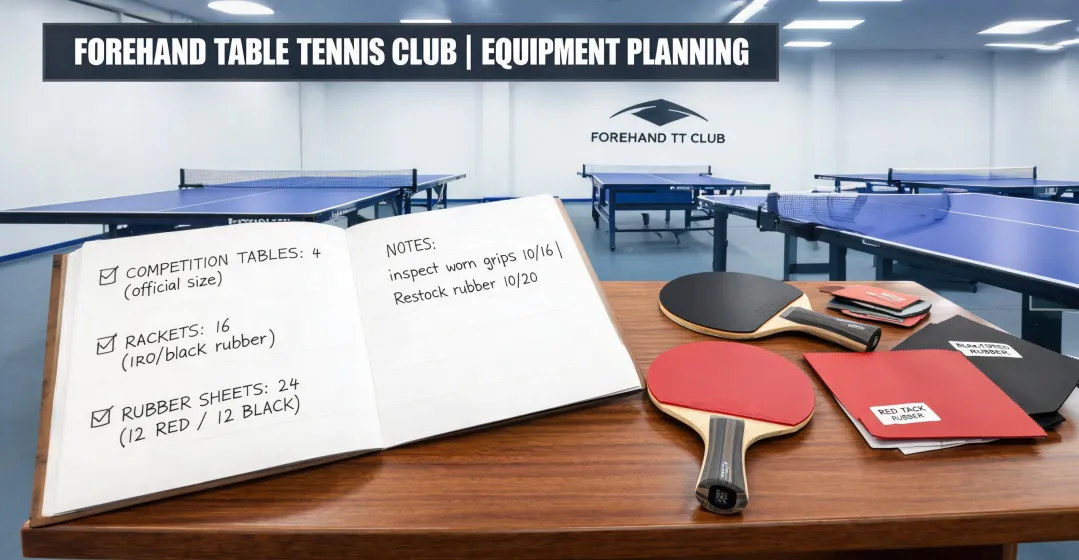
We keep about 10% of active players as loaner rackets. For a 60-player program, that's six loaner rackets plus a small drawer of spare rubbers and edge tape. You don't need a full second setup for everyone.
The failure pattern is predictable: rubbers wear out, blades rarely break. So the spare budget should go into rubbers, not blades. I'm not sure if there's a magic number—it depends on how many visitors and tryouts you host. But our rule is: loaners are entry-level models. The goal is to get someone playing, not to hand them a competition setup worth more than their monthly training fee. Six is better than nothing. Better than sixteen that sit in a cabinet and age.
What's the question every club buyer forgets to ask?
Rubber aging. It starts degrading the moment the package is opened—and even sealed sheets don't last forever. A lot of clubs overstock because they get a good bulk quote, then find themselves replacing dead sheets next season.
I've never fully understood why rubber shelf life isn't talked about more. My best guess is that distributors don't want to discourage bulk orders. Our rule: buy for the coming season, not for the next three years. Keep sheets in a cool, dark place. And don't leave bats near radiators or in car trunks during summer. Heat is the silent killer of Butterfly table tennis rackets.