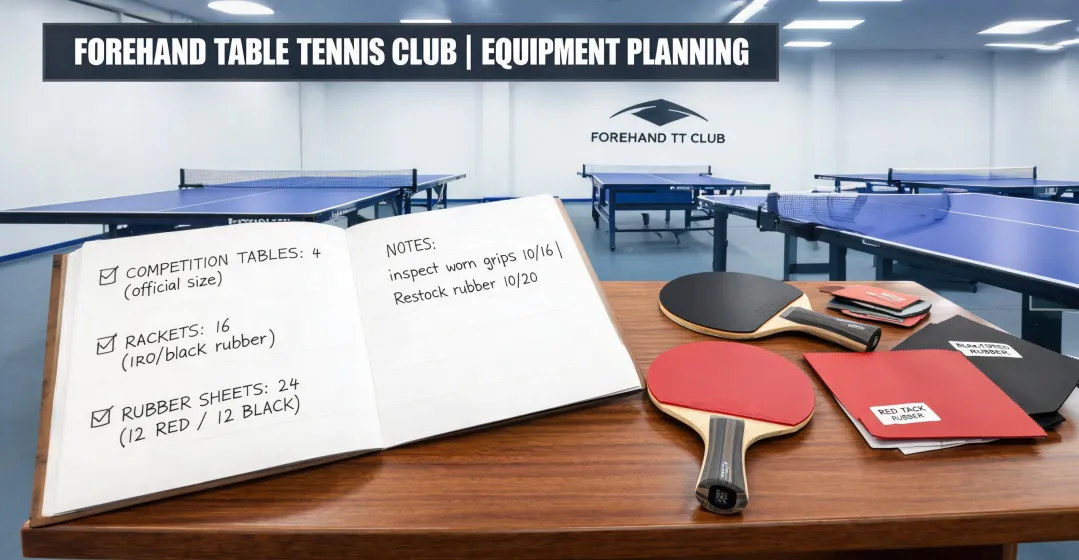
So you're setting up a home gym and you want a proper table tennis setup—maybe a butterfly table, a few good rubbers, a net that won't sag after a month. You've got questions. I get it. I spend my days triaging rush orders for clubs and schools, often with 48-hour deadlines and a client freaking out because the wrong blades showed up.
Here's what I've learned from 200+ of those jobs, in a direct Q&A format. No fluff.
1. I'm on a tight budget. Can I get a quality butterfly table tennis setup without spending a fortune?
Yes—but you have to be smart about it.
The quickest way to overspend is picking a top-tier table (like a Butterfly Centerfold 25) when you actually just need something that rolls away and doesn't warp. For a home gym, you don't need tournament-level bounce consistency. You need something that won't dent the first time you lean on it.
Look at the Rollaway series from Butterfly—the 19mm or 15mm tops. They're not the Centrefold 25, but they're durable, they roll away into a corner, and they cost about 40% less than the premium line. Based on pricing from major retailers as of December 2024, a 19mm rollaway starts around $700, while a Centrefold 25 is $1,400+. That's a huge difference for a home setup.
What I tell clients who are on a budget: spend on the table, save on the blades. Get a decent rollaway. Pair it with a mid-range Butterfly rubber (like Rozena, which is about $40 per sheet) and a lower-mid blade like a Timo Boll 2000 ($60-70). You'll have a setup that feels good, not cheap.
2. What about a table tennis robot for solo practice? Are they worth it?
Honestly? For most home gyms, yes—but only if you're serious about improving.
I've seen a lot of people buy a robot, use it for three weeks, then realize they hate setting it up. The Butterfly Amicus Prime is great—I'm not a robot specialist, but from what I've seen in our orders, it's the most reliable for consistent drills. It's also $1,800-ish for the basic model. That's a chunk of change.
For the casual player: a good practice partner is better. For the serious player: the robot is a no-brainer, provided you commit to using it.
3. How do I choose the right rubber? Everyone says something different.
This gets into territory where personal preference matters more than specs. But here's a practical rule from our internal data (we've processed maybe 150+ rubber orders for home gyms last year):
- Beginner to intermediate: Butterfly Rozena or Sriver. Sriver is a classic, but Rozena has a bit more grip and is more forgiving. Both around $35-45 per sheet.
- Advanced but not pro: Butterfly Dignics 05. It's tacky, it's fast, it's $75 per sheet. If you're not playing in tournaments, you probably don't need it, but it's fun.
- I wouldn't: Go straight to Dignics 09c as a first rubber. It's super tacky and takes a while to get used to. I've seen three clients buy it, then email me a week later asking for a refund because they couldn't control it.
At least, that's been my experience with home gym setups. A club player might disagree—but for a home setup, this works.
4. How important is the net? Can I just use the one that comes with the table?
The net that comes with most Butterfly tables is... fine. It's not terrible. But it's the first thing people upgrade.
I'd say: use the included net for the first few months. If you find yourself adjusting it every session because it's sagging or the tension won't hold, then upgrade to a Butterfly Pro Net or a DHS net. They're about $60-80, and they clamp on tight. One client told me it made a bigger difference than a new blade—which I thought was exaggerated, but it's what they felt.
Bottom line: don't stress about the net until you've played 20+ hours.
5. I've heard Butterfly blades are the best. Which one should I buy first?
This is the most common question I get, and it's the one that stumps me because there's no single answer. But I'll give you what I've seen work across 200+ orders:
- All-round play: Butterfly Viscaria. It's the gold standard for a reason. $280, lasts years if you treat it right.
- Attacking play: Timo Boll ZLC. It's fast, it's stiff, it rewards good technique. $250-280.
- Best value for a home gym: Timo Boll 2000. $65, all-wood, great feel. It's not flashy, but it's solid. I've had three clients say it's the best blade they've bought for their garage setup.
If I had to pick one for a home gym on a reasonable budget: Timo Boll 2000 + Rozena rubber. It's about $140 total for the blade and two sheets. That's a setup that will feel good for years.
6. What's the biggest mistake people make when buying butterfly table tennis equipment for a home gym?
Underestimating the space they need—and buying a table that's too small.
I'm not an architect, so I can't speak to room dimensions generally. What I can tell you from handling dozens of returns: people buy a compact table thinking it'll save space, then realize a 5-foot table feels cramped. The recommended play area for a full-size table (9x5 ft) is at least 40x20 feet. If you can't go that big, get a foldable Butterfly compact table (like the Space Saver), but be prepared for a different feel.
Another one: buying a $30 net and expecting it to last. It won't. But I already covered that.
7. I'm a small gym owner. Can I get reasonable pricing on butterfly equipment for a small batch (4-8 tables)?
This is where I get fired up. Small orders get treated like an afterthought by a lot of suppliers. I've seen it—our company lost a $15,000 contract in 2023 because we tried to save $400 on a standard shipping instead of rush. That was a mistake.
For your small gym, here's what I'd do: reach out to a certified Butterfly dealer directly (not Amazon). Tell them you need 4-6 tables, 20 blades, 40 sheets of rubber, and ask for a bulk rate. Most dealers have a tier for 5+ units that drops the price by 10-15%. It's not massive, but it covers the shipping.
And if they treat you like you're too small to bother with? Find another dealer. There's a lot of people who will respect your business. When I was starting out, the vendors who took my $200 orders seriously are the ones I still use for $20,000 orders. Small doesn't mean unimportant—it means potential.
One last tip from the trenches: always buy an extra net. They break. And they're cheap enough that one spare pays for itself when the club president texts you at 10pm the night before a tournament.