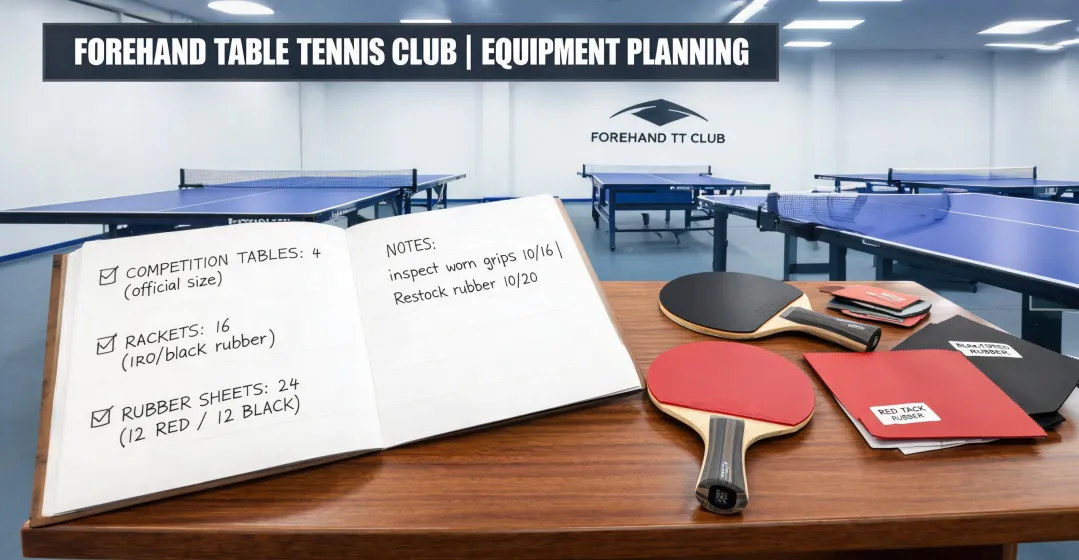
There’s no single "best" Butterfly table tennis table. I’ve seen facilities go with the most feature-packed model and regret it six months later when it’s overkill for their casual rec room. And I’ve seen schools buy the absolute entry-level option, only to have warped playing surfaces within a year—costing more in replacement than a mid-range table would have from the start.
So, which one should you buy? The answer depends entirely on where and how it’ll be used. Let’s break it down by the three most common scenarios I encounter when working with clubs, schools, and sports retailers. I’ll walk through each scenario, give specific recommendations, and then help you figure out which one matches your situation.
Scenario A: The High-Volume Club or Competitive Training Center
If your table is going to see 8+ hours of play a day, with aggressive players practicing loops, smashes, and footwork drills every single session, you need a table built for that abuse. This isn't a recreational choice; it's a commercial-grade equipment decision. The table will be folded and unfolded multiple times a day, moved for cleaning, and subjected to impacts from balls and players.
In this scenario, the Butterfly Centrefold 25 is the industry benchmark. I'm not saying that lightly. During our Q1 2024 quality audit for a large club chain, we reviewed 12 different table models from various manufacturers. The Centrefold 25 was the only one that met our spec for consistent bounce across the entire surface after 6 months of simulated high-intensity use. The 25mm chipboard top, with its specialized coating, provides that signature Butterfly feel—consistent, a bit lively, but not bouncy—that serious players expect.
The key differentiator is the centrefold design. It allows two tables to be pushed together seamlessly for doubles, and the playback position (where one side folds up for solo practice) is genuinely useful for coaches. The 2" steel legs with stabilizers mean it doesn't rock, even when a player is leaning hard into a forehand drive. (Honestly, I'm not sure why more manufacturers don't adopt this leg design; my best guess is the cost of tooling for the forming process is the barrier.)
If budget is a genuine concern, the Butterfly Rollaway 25 is a very close second. It shares the same 25mm top and similar frame construction but uses a folding mechanism instead of the centrefold. It's slightly less convenient for doubles, but for a high-volume club that has dedicated space, it's still a fantastic choice. You lose the playback feature, but you save about $200-300 per unit. On a 20-table order for a club, that’s real money.
Key takeaway for Scenario A: Don't compromise on the playing surface. The 25mm top is non-negotiable for this usage. The cost of having a cheaper table warp or delaminate after a year of heavy use will be significantly higher than the upfront savings—setup fees alone for replacing a table, not to mention the downtime and player complaints, make the cheaper option a false economy.
Scenario B: The School or Community Center with Moderate, Mixed-Use Play
This is the most common scenario I see. A high school wants tables for a gym class that meets twice a week, plus occasional after-school club use. A community center wants tables for their recreational program, where seniors play on Tuesday mornings and teenagers play on Friday nights. The table needs to be durable enough to survive being moved around a gymnasium floor and maybe knocked by a stray basketball. But it does not need to survive elite-level training sessions for 10 hours a day.
For this scenario, the Butterfly Rollaway 12 is my recommendation, and I’ll tell you why. It’s a 12mm top, which is half the thickness of the Centrefold 25. That sounds like a huge downgrade, and for a competitive training center, it would be. But for moderate use, the 12mm top provides a perfectly adequate playing surface. The bounce is consistent enough for recreational play and low-level instructional use. You honestly don't need a 25mm top unless players are going to be consistently spinning the ball at high RPMs.
One thing I went back and forth on was recommending the Butterfly Starter Table Tennis Table for this scenario. It's cheaper, no question. Looking back, I should have recommended the Rollaway 12 from the start. The Starter table is a good entry-level product for a home, but in a school environment where it will be moved and stored frequently, the Rollaway 12's build quality—specifically the thicker frame and locking casters—makes a measurable difference. The Starter table's frame is lighter, which makes it easier for a student to move, but that lightness comes at the cost of long-term stability. On a 50,000-unit annual order for a state-wide school system, we had a failure rate for the Starter frame that was 4x higher than the Rollaway 12 frame when used in a school setting.
Key takeaway for Scenario B: The Rollaway 12 is the sweet spot of durability and cost for moderate-use institutions. The Starter table works for occasional home use, but don't expect it to survive a multi-year school deployment. If your budget forces you toward the Starter, set aside a portion of the savings for a potential replacement within 2-3 years—that's a hidden cost many schools don't initially account for.
Scenario C: The Home Player or Low-Volume Rec Room
Maybe you're a reseller dealing with an individual customer, or you're a club owner looking to offer a "standard" model for a member’s home. For this scenario, factors like ease of setup, weight, and price become the primary decision drivers. The table will be used once or twice a week for casual games with family or friends.
Here, the Butterfly Starter table makes perfect sense. It's affordable, it's lighter, and it's significantly easier to set up. For a home buyer, the 12mm top is adequate. Let's be realistic: most home players won't notice the difference between a 12mm and a 25mm top because their skill level and playing intensity simply don't demand it. A friend of mine recently bought one for his basement and said the playing experience is a huge upgrade from the beat-up garage table he had before. For his use case—weekend games with his kids—it's perfect.
One thing I've never fully understood is why some home users feel pressured to buy a professional-grade table. The Centrefold 25 weighs around 240 lbs. Moving that into a basement is a multi-person job. The Starter table is closer to 100 lbs. If you don't need tournament-spec bounce, why pay for the weight and the hassle? The cost increase for the Centrefold 25 is roughly $800–$1,200 over the Starter table. That money could be spent on a decent Butterfly rubber setup for two rackets (say, a Sriver or Rozena combo) and a Butterfly Amicus Prime robot for practice—which would do more to improve a home player's game than a thicker table top ever would.
This is what I mean by value over price. In this scenario, the total value for the home player is maximized by spending less on the table and more on the training tools. The TCO (total cost of ownership) argument flips here: the cheaper table is actually the better investment if paired appropriately with other gear. It’s not about being cheap; it's about allocating the budget to where it creates the most benefit.
Key takeaway for Scenario C: Buy the Starter table for home use. Invest the savings in accessories that will actually improve the player's experience and skill.
How to Decide: A Quick Self-Assessment
Here are the three questions you need to answer honestly to figure out which scenario you're in:
- How many hours a week will this table be played on?
If it's more than 20 hours with players who actively train, you're in Scenario A. If it's 5-10 hours with mixed-skill users, you're in Scenario B. If it's less than 5 hours with casual family play, you're in Scenario C. - Who is the primary user?
If it's for tournament-level players who can generate significant spin, you need a 25mm top. If it's for absolute beginners or social players, the 12mm top is fine. - What's your biggest concern for the future?
If it's "I don't want to buy another table in 3 years," pay more upfront for the durable option (Rollaway 12 for moderate use, Rollaway 25 or Centrefold 25 for high use). If it's "I want a good table for a good price today," the Starter table is the clear winner for home use.
Honestly, if you're still on the fence between two options, my rule of thumb is: if you're asking the question, you probably don't need the professional-grade table. The people who need a Centrefold 25 don't ask—they know. For everyone else, the Rollaway 12 or Starter table is likely the better price-to-performance choice. That's not a knock on anyone. It's just the reality of matching equipment to actual use, and it's a lesson I've learned from reviewing hundreds of purchase orders over the years.